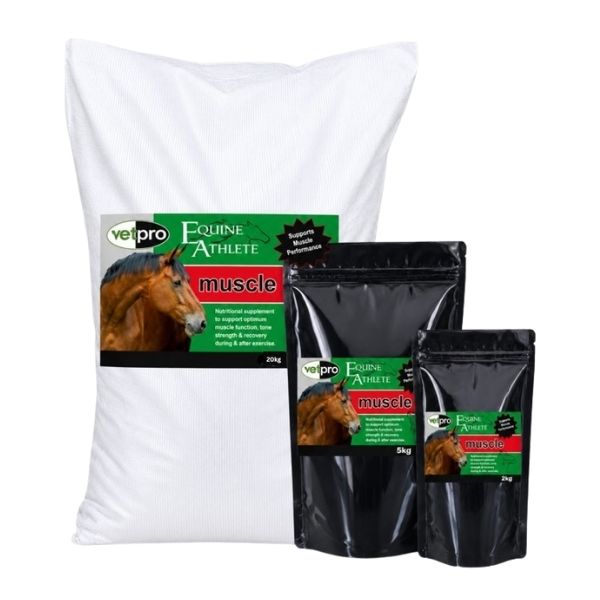

What is Vetpro Muscle-Max?
Vetpro Muscle-Max is a 100% natural multi-tasking nutraceutical that can assist many horses and ponies for different reasons. Vetpro Muscle-Max is ideal for hard-working horses, older horses, poorly conditioned horses, “hot” horses over-energised by carbohydrates, horses showing difficulties with digestion, overweight horses and those needing support for their immune systems.
- It is a fat-based feed source to provide energy without the hype of carbohydrate feedstuffs that can create too much energy, sometimes making management a challenge.
- It contains elements that improve muscle mass and therefore strength and stamina.
- Other elements reduce the negative effects of exercise on muscles and so improve recovery, as well as helping to convert fat to muscle.
- It is very easy for the horse to digest and can even help the digestion process by slowing the rate the feed moves through the gut. This allows for efficient digestion and reduces discomfort (gut pain) for the horse.
- It contains gamma oryzanol which offsets the damage from hard exercise (Ostaszewski et al., 2012).
- It provides a very high level of efficient antioxidants which protect muscle from free radical damage caused by hard exercise.
- Science has shown that rice bran has a beneficial influence on the immune system and anti-allergenic properties (Park et al., 2017).
- It is concentrated, so at a supplement level it means that it does not take up room in the feed bucket.
How Does Vetpro Muscle-Max Support Muscle Metabolism?
Essentially, it is a feed supplement formulated to maximise the efficiency of muscle metabolism. It does this in two ways, by improving lean muscle mass and by reducing the effects of post-exercise muscle fatigue.
Waste products from the energy-burning process include water, carbon dioxide, ammonia, lactic acid and free radicals, all of which have the potential to reduce muscular efficiency.
Free radicals can cause serious damage to the muscle cell membrane. It is these free radicals, in conjunction with the waste ammonia and lactic acid, that many equine sport scientists believe are responsible for muscle fatigue and post-exercise muscle soreness (Mowry et al., 2022).
How Do Antioxidants Help Horse Muscle Recovery?
Antioxidants are substances that inactivate the free radicals within the cell.
There are many nutritional antioxidants, mostly found in plants. Vetpro Muscle-Max is an antioxidant supplement that contains stabilised rice bran, a rich source of glycerides, free fatty acids, phospholipids and glycolipids.
Its principal antioxidants are the tocopherols, tocotrienols and gamma oryzanol, as well as inositol, phytic acid and choline.
Vitamin E is one of the tocopherols found in Vetpro Muscle-Max, but it is the tocotrienols, which are many times more potent than Vitamin E, that make it such a potent antioxidant formulation (Chong et al., 2025).
Gamma oryzanol is a natural component of rice bran and, as well as acting as an antioxidant, it has also been shown to reduce muscle fatigue and improve appetite.
Why Does Vetpro Muscle-Max Contain Chromium?
Vetpro Muscle-Max also contains chromium picolinate, which is not an antioxidant but is a natural chromium salt.
Supplementing horses can ensure the maintenance of muscle homeostasis. It has been shown to increase the rate at which glucose is metabolised and to lower blood lactic acid levels during exercise.
Research in the USA has shown that racehorses in full training, supplemented with 5 mg per day, had 13% lower blood lactate levels after intense exercise than the control horses used in the study (Pagan et al., 1995).
In Summary
In summary, Vetpro Muscle-Max combines the antioxidant properties of stabilised rice bran and, along with chromium picolinate, helps to reduce muscle fatigue and post-exercise muscle damage.
It also creates muscle gain and a reduction in body fat. It is a 100% natural product that can be used right up to and during competition. It is formulated with an apple flavour that horses find palatable.
Daily Dose and Product Information for Vetpro Muscle-Max
Available sizes: 2 kg, 5 kg and 20 kg.
| Horse | Recommended Daily Dose |
|---|---|
| Ponies | 60 g |
| Yearlings | 160 g |
| Sport Horses | 80–100 g |
| Performance & Racehorses | 160 g |
| Underweight Horses | 160 g |
The dose rate can easily be adjusted to suit horses’ individual needs.
FAQs
Why does the energy from rice bran not make a horse hyper?
Because it is a fat-based source of energy. It is carbohydrates such as grains that can make a horse too energetic.
Does a horse gain weight with rice bran?
They can. It is useful to help a thin horse improve condition. The amount of the daily dose of Vetpro Muscle-Max can be adjusted so weight gain is not an issue, and chromium will help prevent fat pads.
With phosphorus being in rice bran, will it affect the calcium-phosphorus ratio?
Yes, it can if larger doses are given. It is important to make sure sufficient calcium is in the diet. Adding a fully formulated mineral mix or feeding lucerne chaff will be beneficial. Vetpro Muscle-Max is not a feed, so a supplement amount is unlikely to be a problem.
Will rice bran help improve the horse’s coat?
Yes, the oil and the antioxidants in the rice bran will help to produce a glossy, healthy coat.
Is Vetpro Muscle-Max good for older horses?
Yes, the rice bran is easily digested by the older horse and can assist in maintaining muscle mass (Filipiak et al., 2022).
Scientific References
Chong, J. Y., Huang, T.-C., Chueh, S.-M., Ma, C.-Y., Kuo, T.-T., He, J.-J., Lo, Y.-J., Peng, K.-C., Ali, M., Chang, H.-Y., & Hsia, S.-M. (2025). γ-Tocotrienol attenuates oxidative stress and preserves mitochondrial function in inflammation-induced muscle atrophy. Redox Biology, 87, Article 103874. https://doi.org/10.1016/j.redox.2025.103874
Filipiak, W., Cieślak, A., Gogulski, M., Kołodziejski, P., & Szumacher-Strabel, M. (2022). Rice bran in old horses nutrition and its influence on condition, blood biochemical parameters, total faeces bacteria and methanogen population. Annals of Animal Science, 23(1), 173–183.https://doi.org/10.2478/aoas-2022-0051
Mowry, K., Thomson, T., Morales, C., Smith, R., Fikes, K., & Suagee-Bedore, J. (2022). 15 potential benefits of rice bran oil for lightly worked young horses. Journal of Animal Science, 100(Supplement 1), 13–14. https://doi.org/10.1093/jas/skac028.025
Ostaszewski, P., Kowalska, A., Szarska, E., Szpotański, P., Cywińska, A., Bałasińska, B., & Sadkowski, T. (2012). Effects of β-hydroxy-β-methylbutyrate and γ-oryzanol on blood biochemical markers in exercising Thoroughbred race horses. Journal of Equine Veterinary Science, 32(9), 542–551. https://doi.org/10.1016/j.jevs.2012.01.002
Ott, E. A., & Kivipelto, J. (1999). Influence of chromium tripicolinate on growth and glucose metabolism in yearling horses. Journal of Animal Science, 77(11), 3022–3030.https://doi.org/10.2527/1999.77113022x
Pagan, J. D., Jackson, S. G., & Duren, S. E. (1995). The effect of chromium supplementation on metabolic response to exercise in Thoroughbred horses. Proceedings of the 14th Equine Nutrition and Physiology Society Symposium.
Park, H. Y., Lee, K. W., & Choi, H. D. (2017). Rice bran constituents: Immunomodulatory and therapeutic activities. Food & Function, 8(3), 935–943. https://doi.org/10.1039/c6fo01763k
Roschek, B., Jr., Fink, R. C., Li, D., McMichael, M., Tower, C. M., Smith, R. D., & Alberte, R. S. (2009). Pro-inflammatory enzymes, cyclooxygenase 1, cyclooxygenase 2, and 5-lipooxygenase, inhibited by stabilized rice bran extracts. Journal of Medicinal Food, 12(3), 615–623. https://doi.org/10.1089/jmf.2008.0133
Spears, J. W., Lloyd, K. E., Siciliano, P., Pratt-Phillips, S., Goertzen, E. W., McLeod, S. J., Moore, J., Krafka, K., Hyda, J., & Rounds, W. (2020). Chromium propionate increases insulin sensitivity in horses following oral and intravenous carbohydrate administration. Journal of Animal Science, 98(4), Article skaa095. https://doi.org/10.1093/jas/skaa095