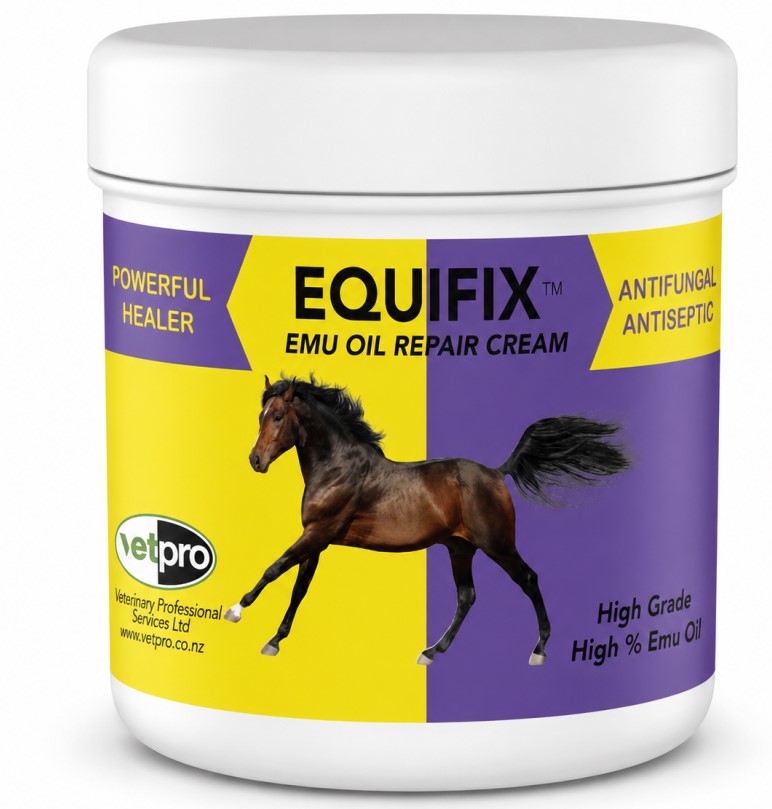
Emu oil was discovered by the Aborigines many thousands of years ago. It has been utilised in Aboriginal culture as an antiseptic, analgesic and nutrient.
It has since been recognised for joint aches and pains, sunburn, as a moisturiser and to encourage skin repair. Emu oil has been discovered to be bacteriostatic, which means that it does not promote the growth of bacteria. It is also hypoallergenic and non-comedogenic, meaning it has low skin irritation and does not clog pores.
From a veterinary aspect, emu oil provides a pharmaceutical-free, economical, natural option in the treatment of minor wounds, scar tissue and fungal skin conditions.
It may be used on scar formations, utilising its ability to promote normal tissue formation with 15% better collagen rejuvenation.
The strict restraints in the equine field for the use of drugs during and preceding competition mean that Equifix Emu Oil Repair Cream provides a unique treatment regime for the equine athlete, able to be used in competitive and racing conditions.
It is important that emu oil alone should not be used on the skin as it may burn. It needs to be provided in an aqueous cream base.
It can then be applied directly to minor wounds, skin irritations, burns, swollen areas and mud fever areas.
For wounds, gently clean the area with water, dry and apply the Equifix. Repeat daily. Expect to see sloughing; wash and wipe to remove it, then apply Equifix to cover the area.
If there are signs of infection, an increase in the affected area or other concerns, refer to a veterinarian.
Equifix Emu Oil Repair Cream is a topical application using the powerful healing properties of emu oil. It contains a high percentage of high-quality emu oil in an aqueous base to encourage healing and epithelialisation.
Ideal for horses and dogs, and even humans, it has many useful applications, not just minor wounds but fungal irritations, minor swellings, flaking skin and hot spots on dogs.
For fungal irritations, ideally use after Vetpro Fungal Shampoo.
It is a safe and useful go-to ointment.
Available size: 200 g pots.
Research has been conducted in the USA and Australia investigating the oil’s beneficial effects on arthritis and joint pain and for the treatment of cancer.
It has become evident that the high levels of linoleic acid and oleic acid in emu oil have anti-inflammatory effects, as well as having the ability to actively transport other bioactive substances through the lipid layer of tissues such as skin and stomach wall.
The research and anecdotal clinical data have provided exciting results.
In Australia in 2002, the Therapeutic Goods Administration recognised emu oil as a therapeutic active ingredient and listed emu oil on the Australian Register.
Dr M. Zimmer from the USA has also discovered in clinical trials that antibiotics are carried into the deep tissue by the emu oil, thus allowing deep local treatment of infected dermal wounds.
This means cost-effective, efficacious local treatment of wounds. In horses this is particularly exciting as the cost of many antibiotics can be prohibitive and it means the most appropriate antibiotic can be used as a topical application.
Dr Robert Nicolosi, University of Massachusetts, reported on animal trials that showed cholesterol-lowering, anti-inflammatory and transdermal properties of emu oil.
Dr Nicolosi was selected to perform the emu oil studies because of his widely recognised publications on vegetable oils, sterols and lecithin. He has published more than 150 peer-reviewed papers in many noted journals on nutrition. Dr Nicolosi holds teaching and research positions at the University of Massachusetts.
He stated that inflammation is easily seen but more difficult to quantify. The results were again “incredible”. The degree of inflammation was significantly reduced by between 42% and 71% in the emu oil-treated mice.
The cytokines, or those circulatory compounds produced as a result of inflammation, were also reduced significantly: 83% for interleukin-1 and 66% for tumour necrosis factor.
Several human and animal diseases are probably the result of inflammation. These include arthritis and vascular diseases. Treatment is often difficult, but topical application has been explored. Substances that pass through the skin are needed.
These trials showed statistically that emu oil is transdermal and can be utilised for transdermal delivery.
Nicolosi, R., Yoganathan, S., Wilson, T., Sasaki, H., & Orthoefer, F. (2001). Biological activity of emu oil [Conference presentation]. AOCS Annual Meeting.
Politis, M. J., & Dmytrowich, A. (1998). Promotion of second intention wound healing by emu oil lotion: Comparative results with furasin, polysporin, and cortisone. Plastic and Reconstructive Surgery, 102(7), 2404–2407. https://doi.org/10.1097/00006534-199812000-00020
Whitehouse, M. W., Turner, A. G., Davis, C. K., & Roberts, M. S. (1998). Emu oil(s): A source of non-toxic transdermal anti-inflammatory agents in aboriginal medicine. Inflammopharmacology, 6(1), 1–8. https://doi.org/10.1007/s10787-998-0001-9