The stomach of the horse produces acid 24/7, unlike a human stomach that only secretes acid when a signal is triggered by enzymes in the mouth indicating food is coming. This makes the horse vulnerable to damage to the stomach wall and the potential for ulcers to develop.
In its natural environment the horse is a grazing animal, regularly taking in grass and legumes throughout the day and night. These stay in the stomach and offset the acid and its negative effects. Humans interfere with this naturally evolved behaviour by using a horse for recreational, work and sporting demands, feeding grain feeds and undertaking intensive exercise such as racing (Lorenzo-Figueras & Merritt, 2002).
These changes from a natural lifestyle can mean the stomach is left empty for periods of time because the grazing time of the horse is restricted, travelling a horse or other times when a horse has to be stabled and hay is not constantly available.
Overweight horses and ponies are also vulnerable due to dietary controls to reduce their weight. So, at times of work demands, high grain feeds or in conditions of grazing restriction, there is a need to neutralise the acid to prevent damage to the mucosa of the stomach.
Acid splash occurs when a horse is exercised on an empty stomach and acid splashes up onto the upper stomach lining which is particularly sensitive. It is common in racehorses and competitive riding horses, but also horses on high grain diets or those being transported over long distances.
The result may be an ulcer, and the pain can affect the attitude of the horse and its performance in any genre of horse sports. They change their attitude, becoming irritable and non-compliant. Sometimes girthing up brings a negative response, teeth grinding, loss of appetite and weight loss, and a poor coat (Vokes et al., 2023).
Generally, horses with a placid, easy-going disposition show fewer signs than more sensitive types. A veterinarian will investigate and use a gastroscope to diagnose an ulcer and prescribe a 28-day course of Omeprazole to resolve the ulcer. It is after the end of the course that support is needed.
The option of continuing with omeprazole is not a good one. It does create negative health issues for the horse including a reduced absorption of calcium (Pagan et al., 2020).
Studies have shown that a rebound of hyperacidity can occur even when a horse is restricted for a few days prior to racing (Shan et al., 2023).
If Omeprazole is continued along with the use of NSAIDs such as phenylbutazone, then disruption to hindgut function is a result. There is also evidence that it becomes less efficient with an extended application (Sykes, 2021).
So, if conditions of the environment, use and feeding of the horse are not changed then the problem of ulcers may come again.
Being able to neutralise acid for the period of time that the horse is in work, racing, travelling or on restricted forage intake is an ideal solution.
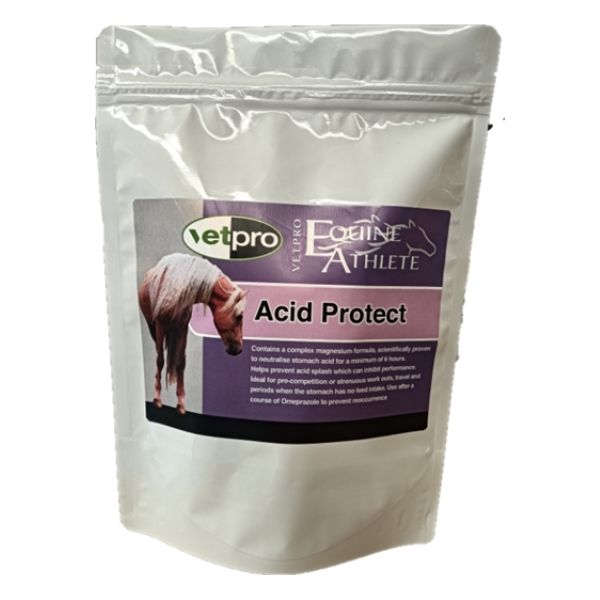
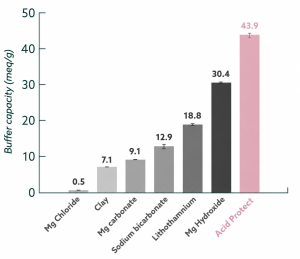
Vetpro Acid Protect has been internationally developed and scientifically proven to neutralise acid in the stomach to prevent damage to the stomach mucosa (Leleu & Couroucé, 2023).
Vetpro Acid Protect does provide a minimum of 6 hours acid neutralisation which can cover the period of time a horse is vulnerable to acid damage (VSN, 2021). It can be given twice a day to cover a minimum of 12 hours of vulnerable time.
Times when the horse has no food in the stomach, e.g. travelling, competing, restricted grazing, racing and high grain feeds.
By supplementing with an acid neutraliser. By creating a more natural environment with access to pasture for 24 hours. Reduce high carbohydrate feeds, add fats for energy, add lucerne chaff to the feed and feed smaller, more frequent feeds.
An increase in acid levels (a rebound) can occur for a few days. Rest the horse and provide plenty of natural fodder and lucerne chaff to assist over this period. Unless changes are made to a more natural feeding environment, the horse will be vulnerable to stomach acid. Feed a supplement to neutralise the acid daily.
Available sizes: 1 kg, 2.5 kg and 6 kg.
Ingredients: Complex Multi Magnesium Compound.
Dose rate: 20 g per 500 kg horse daily to cover 6-hour periods of work, travel, feed restrictions etc., or twice daily for 12-hour protection.
Studies Effect of a Blend of Magnesium Oxide on Equine Squamous Gastric Disease in Young Trotter Horses Under Training
Leleu, C., & Couroucé, A. (2023). Journal of Veterinary Science, 24(6), e118.
https://doi.org/10.4142/jvs.23118
In-Vitro Evaluation of Gastric pH and Kinetics in Horses
Veterinary School of Nantes, Inovalys Laboratory. (2021).
Effects of Treatment with Omeprazole or Ranitidine on Gastric Squamous Ulceration in Racing Thoroughbreds
Lester, G. D., Smith, R. L., & Robertson, I. D. (2005). Journal of the American Veterinary Medical Association, 227(10), 1636–1639.
https://doi.org/10.2460/javma.2005.227.1636
Effects of Exercise on Gastric Volume and pH in the Proximal Portion of the Stomach of Horses
Lorenzo-Figueras, M., & Merritt, A. M. (2002). American Journal of Veterinary Research, 63(11), 1481–1487.
https://doi.org/10.2460/ajvr.2002.63.1481
Omeprazole Reduces Calcium Digestibility in Thoroughbred Horses
Pagan, J. D., Petroski-Rose, L., Mann, A., & Hauss, A. (2020). Journal of Equine Veterinary Science, 86, Article 102851.
https://doi.org/10.1016/j.jevs.2019.102851
The Impact of Two Recommended Withholding Periods for Omeprazole and the Use of a Nutraceutical Supplement on Recurrence of Equine Gastric Ulcer Syndrome in Thoroughbred Racehorses
Shan, R., Steel, C. M., & Sykes, B. (2023). Animals, 13(11), Article 1823.
https://doi.org/10.3390/ani13111823
A Free Ride: Is Long-Term Omeprazole Therapy Safe and Effective?
Sykes, B. W. (2021). Equine Veterinary Education, 33(10), 556–560.
https://doi.org/10.1111/eve.13458
Equine Gastric Ulcer Syndrome: An Update on Current Knowledge
Vokes, J., Lovett, A., & Sykes, B. (2023). Animals, 13(7), Article 1261.
https://doi.org/10.3390/ani13071261