Older horses appear old as they often lose their topline and muscle mass.
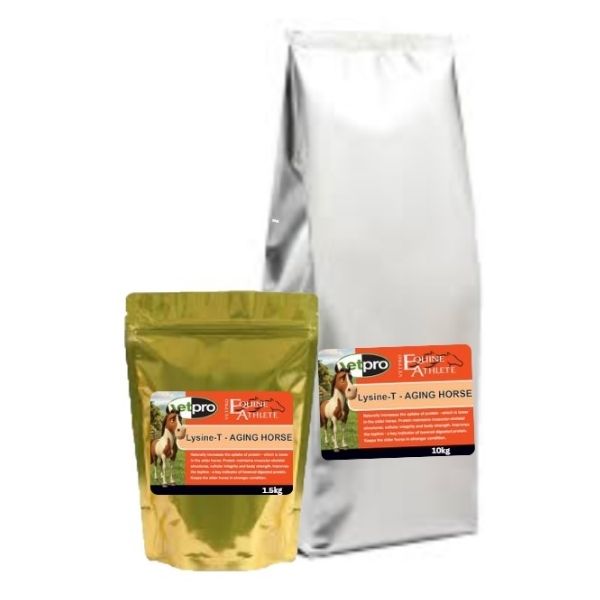
Vetpro Lysine-T for the Older Horse is formulated to provide the two limiting essential amino acids, lysine and threonine. Rather than increasing the total amount of protein in the diet, it is designed to help older horses make better use of the digestible protein they are already eating, supporting muscle mass, topline and overall condition as they age.
The reason for this loss is that an older horse is unable to absorb all the protein that they eat and, as well as affecting the visual appearance of the outline of the horse, it is also having a detrimental effect on the internal health of the horse.
Protein is needed for muscle, blood, skeleton and organs, hormones, enzymes and antibodies (immune system) – basically most body functions.
Protein is a collection of amino acids, much like bricks in a wall.
There are two types, essential and non-essential. The latter can be ingested or mainly created within the body of the horse. The essential ones must be taken up from the diet.
There are only two limiting amino acids, these are Lysine and Threonine. Limiting means that if these two are not in the diet, then protein is blocked.
Increasing the amount of protein (or a protein supplement) is detrimental to the health of the horse.
Supplementing with Lysine and Threonine is the answer (Graham-Thiers & Kronfeld, 2005).
It will not have any negative impact but will help the horse to process all the digestible protein available.
To use the wall analogy, without these two important bricks, the wall will break down.
Not only will it help the look of the horse, but it will also help maintain the strength and therefore result in a longer useful life where exercise and involvement with others can continue into an older age.
A measure for the daily requirement of lysine for a 500 kg horse is 27 g (National Research Council, 2007) and it has been calculated that threonine is 0.62 of that, so ideally 16–17 g (Mok & Urschel, 2020).
It is important to check the amount being fed in premix feeds and adjust the amount being supplemented accordingly, adjusting for the amount of the feed compared to the recommended amount which will show a total amount.
For example, if you feed 2 kg of premix instead of a recommended 4 kg then halve the estimated amount of Lysine and Threonine actually in the horse’s feed.
Another nutritional support is the product Vetpro Muscle Max.
View the Vetpro Muscle Max product page.
Very easily digested, a fat-based supplement with no carbohydrates but provides safe energy and good healthy condition.
This refers to the fact that if they are not available, and in sufficient quantity, it means that the protein that the horse eats will not be absorbed and that seriously affects the total health of the horse.
Yes, it can be, but it is very rare. The horse must excrete the excess and will drink more water and urinate more frequently. It can be noticed by an ammonia smell in the stable.
By improving the uptake of digestible protein which builds muscle as well as providing full health benefits.
Most older horses will benefit from supplementation. Measure by assessing how much is in the feeds from the details on the label. Generally, feeding quality lucerne will provide at least 50% of the daily need.
Graham-Thiers, P. M., & Kronfeld, D. S. (2005). Amino acid supplementation improves muscle mass in aged and young horses. Journal of Animal Science, 83(12), 2783–2788. https://doi.org/10.2527/2005.83122783x
Mok, C. H., & Urschel, K. L. (2020). Amino acid requirements in horses. Asian-Australasian Journal of Animal Sciences, 33(5), 679–695. https://doi.org/10.5713/ajas.20.0050
National Research Council. (2007). Nutrient requirements of horses (6th rev. ed.). National Academies Press. https://doi.org/10.17226/11653