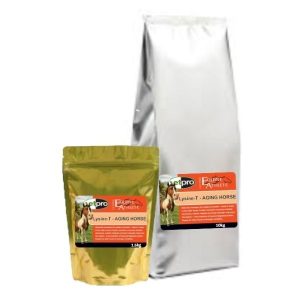

Learn why Lysine and Threonine are important for horses – especially young, older and breeding horses
Quick Summary: Protein is essential for muscle development, but overfeeding it is not healthy. Supplementing with Lysine and Threonine – the “limiting amino acids” – is the safe answer to maximizing the uptake of available protein for growth and tissue repair.
Protein is made up of 20 amino acids and Lysine and Threonine are defined as limiting amino acids (NRC., 2007), which means that this pair are important as they must be available in sufficient quantity so that protein (all the other amino acids) can be absorbed by the horse.
Think of protein as a wall of bricks… each brick is an amino acid such as proline, leucine, alanine etc. The Lysine and Threonine are the key structurally linking bricks that the wall must have for its strength and viability.
Protein is essential for muscle development, tissue repair and metabolic functions of the horse, however, overfeeding protein, or protein supplements, is not healthy for the horse.
Supplementing with Lysine and Threonine is the safe answer to maximising the uptake of available protein.
Which Horses Benefit Most from Lysine &Threonine Supplementation? (Life Stage Critical Points)
- The lactating mare with a foal at foot who is totally reliant on the mare’s milk. Scientific research shows that lysine and threonine supplementation in grazing lactating mares enhanced milk production and improved milk protein and fat quality (Lin et al., 2024).
- The weanling and growing horses. A time of intense growth, often they are given extra hard feed to try and improve growth to present a more impressive and possibly more able animal for the racing industry.
Science has shown that overfeeding full protein and particularly carbohydrates can lead to skeletal and joint failings in the young horse. Feeding less but supplementing with Lysine and Threonine can improve growth without the potential negative outcomes, has been shown as a solution (Ott, Asquith, Feaster., 1981). ⟶ Learn more about developing the growth of the young horse safely here.
- The older horse. At a later stage in life the ability of the horse to digest and process the protein in their feed is reduced and so results in a loss of muscle and body mass. Also depleted is their immune system, and the coat appears dull and hoof quality is reduced. Increasing the amount of protein in the feed is not a solution as it is not digested and can create complications.
It has been scientifically shown that supplementing lysine and threonine does assist the uptake of the protein and offsets the loss of muscle mass (Graham-Thiers, & Kronfeld., 2005). This is often seen in an improvement in the topline of the older horse, the general condition and physiology. This means that early retirement of a sound horse can be delayed, thus extending their useful life and delaying the discard into the paddock. ⟶ Learn more about the feeding of older horses here.
How much Lysine and Threonine does a horse need?
How much does a horse need to help either the breeding mare, the young horse or the older horse?
To know how much to give your horse, it is necessary to check how much may already be in your feed. Check out labels of premix feeds and remember that if you are not feeding their recommended daily amount, then you will not be delivering the amount of the supplement that is shown in the list.
Feeding 2kg per day of a premix feed when 4kg is the recommended daily intake, means only half the quantity of the ingredients is being given.
Add up the amount of lysine and threonine in the forage, for example a kg of lucerne chaff will provide 7.7gm of lysine and 6.5gm of threonine. Meadow hay is only 5.7gm of each and basic pasture is negligible.
| Recommended Daily Supplement levels | Lysine | Threonine |
|---|---|---|
| Third Trimester Brood Mare | 36gm | 24gm |
| Lactating Mare | 60 gm | 40gm |
| Weanling | 18-22 gm | 11-14 gm |
| Yearling | 20-25 gm | 12-19 gm |
| Older Horse | 25-30 gm | 15-20 gm |
Summary of Benefits
A supplement with the correct ratios of Lysine and Threonine is needed at certain times in the life of a horse to ensure that digestible protein is at the maximum level to improve the health of the horse, without the risk of overfeeding protein or overuse of carbohydrates for growth.
Correct levels of protein are vital to the health of every horse as it plays a central role in muscle development, the repair of tissues and the metabolic functions of the animal.
Amino acids are the constituents of protein but can only be utilised if the limiting ones, i.e. Lysine and Threonine are present in sufficient quantity.
Often the pasture and feeds do not provide the necessary amounts for the specific stages in the life of a horse – mares in foal, young growing horses and the older horse.
FAQ
No. Overfeeding total protein can lead to metabolic stress and skeletal issues in young horses. Supplementing specifically with “limiting amino acids” like Lysine is a safer, more effective way to support muscle growth.
Lysine and Threonine are called “limiting” because if the horse doesn’t have enough of them, they cannot utilize any of the other protein in their diet, regardless of how much you feed.
As horses age, their ability to digest bulk protein decreases, leading to muscle loss along the topline. Instead of overloading their digestive system with high-protein feeds, which can cause metabolic complications, supplementing specifically with the limiting amino acids Lysine and Threonine helps their body efficiently utilize the protein they already consume, safely rebuilding muscle mass.
Scientific References
Graham-Thiers, P. M., & Kronfeld, D. S. (2005). Amino acid supplementation in growing horses. Journal of Animal Science, 83(E. Suppl.), E248–E255.
Graham-Thiers, P. M., & Kronfeld, D. S. (2005). Amino acid supplementation improves muscle mass in aged and young horses. Journal of Animal Science, 83(11), 2783–2788.
Graham-Thiers, P. M., Kronfeld, D. S., & Kline, K. A. (2006). Dietary protein influences acid–base responses to repeated sprints. Journal of Animal Science, 84(3), 695–704.
Graham, P. M., Ott, E. A., Brendemuhl, J. H., & Ten Broeck, S. H. (1994). The effect of supplemental lysine and threonine on growth and development of yearling horses. Journal of Animal Science, 72(2), 380–386.
Lin, J., et al. (2024). Effects of lysine and threonine on milk yield, amino acid metabolism and fecal microbiota of Yili lactating mares. Journal of Animal Science and Biotechnology, 15, Article 43. https://doi.org/10.1186/s40104-024-00992-9
National Research Council. (2007). Nutrient requirements of horses (6th rev. ed.). National Academies Press. https://doi.org/10.17226/11653
Ott, E. A., & Asquith, R. L. (1986). Amino acid supplementation in horse diets. Journal of Animal Science, 63(4), 1219–1226.
Ott, E. A., Asquith, R. L., & Feaster, J. P. (1981). Lysine supplementation of diets for yearling horses. Journal of Animal Science, 53(6), 1496–1503.
Ott, E. A., & Kivipelto, J. (1988). Influence of energy and protein content of the concentrate and restricting concentrate intake on growth and development of weanling horses. Professional Animal Scientist, 4(4), 302–311.
Staniar, W. B., Kronfeld, D. S., Wilson, J. A., Lawrence, L. A., Cooper, W. L., & Harris, P. A. (2001). Growth of Thoroughbreds fed a low-protein supplement fortified with lysine and threonine. Journal of Animal Science, 79(8), 2143–2151.